What Post-Launch Support Really Means
Most people hiring a developer picture the finish line as launch day: the app goes live, the invoice clears, everyone moves on. Then real users show up — and that's when a whole category of work you may not have budgeted for begins. If you're hiring a freelance developer, post-launch support is one of the most important things to get straight before you sign, and one of the most commonly skipped. Here's what it actually covers, what it doesn't, and how to make sure it's real instead of assumed.
What Is Post-Launch Support When You Hire a Freelance Developer?
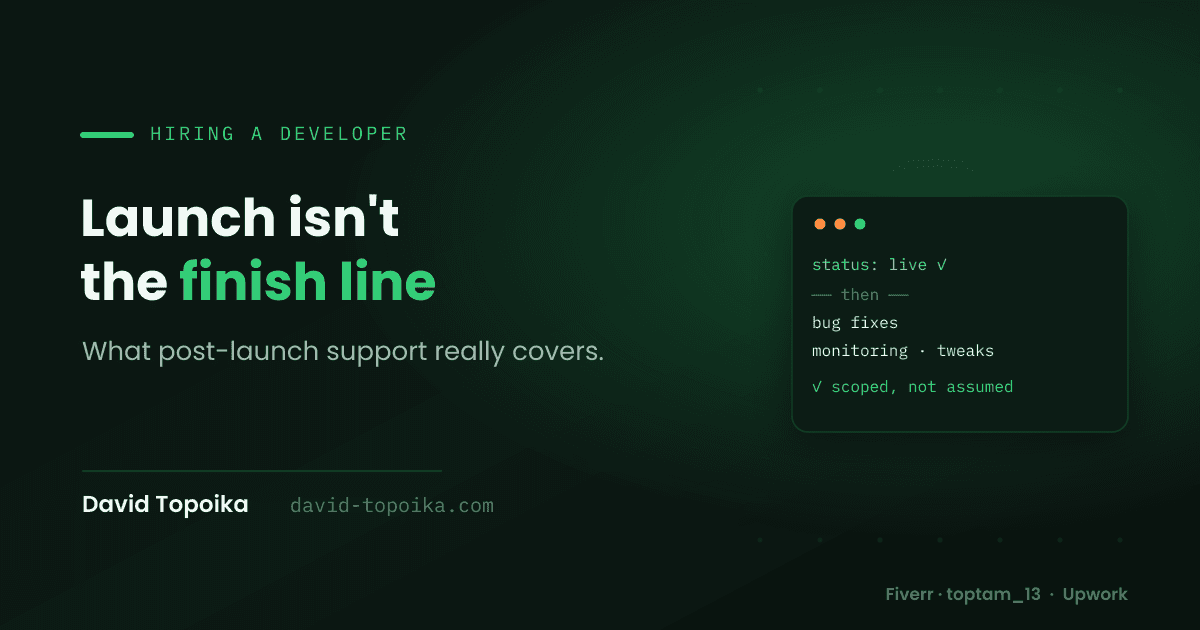
Post-launch support is the work that keeps your app healthy after it goes live: fixing bugs that only surface with real users, monitoring for errors and downtime, making small adjustments, and keeping the app compatible as phones, browsers, and app stores change. It's ongoing maintenance — distinct from building new features — and it's the phase that decides whether launch is a beginning or a cliff.
Everything below is how to tell good post-launch support from a vague promise, and how to lock it down in writing.
Why Launching Your App Isn't the Finish Line
Software isn't a physical product you build once and hand over. It runs in a world that keeps moving underneath it. Studies of the software lifecycle have long shown that maintenance accounts for the majority of a system's total cost — often more than the original build — precisely because a live app never really sits still.
Concretely, the ground shifts in ways that have nothing to do with your code being "wrong":
- Operating systems update, and something that worked on last year's iOS or Android starts misbehaving.
- App stores raise their requirements — Google Play forces apps to target a recent Android API level or risk being delisted, and Apple's App Store review rules evolve too.
- A third-party API your app depends on changes, deprecates an endpoint, or rotates a key.
- Traffic grows and something that was fast at ten users gets slow at ten thousand.
None of that is a defect at launch. All of it lands after launch — which is exactly why "we shipped it" and "we're done" are two different statements.
What Real Users Reveal That Testing and Demos Never Do
A demo is a happy path walked by someone who knows exactly where to step. Real users don't cooperate. They tap the button nobody tapped in testing, paste emoji into the name field, lose signal mid-payment, and open the app on a phone you've never heard of. That's not a failure of testing — it's the nature of it. No test suite models the messy reality of thousands of real people using software in ways you didn't anticipate.
So the first weeks after launch are where the actual edge cases appear: the form that breaks on one Android keyboard, the screen that's unusable on a small display, the race condition that only shows up under real concurrent load. Good post-launch support is what catches these while they're small annoyances instead of one-star reviews.
A concrete example I've run into: a payment flow that passed every test can still double-charge a customer on its first busy day, because real, concurrent traffic creates race conditions a demo never reproduces — exactly the kind of double-payment bug that only a live system exposes. Caught in the first week, it's a quick fix and a small apology. Caught in month three through a wave of chargebacks, it's a trust problem and a pile of refunds. Same bug, very different cost — and the only thing separating the two is whether someone was watching after launch.
Good post-launch support is also, frankly, where a developer earns a client's trust for the next project — a point I dug into in what it takes to earn 5-star reviews as a remote developer.
What Post-Launch Support Should Include (and What's a New Project)
This is where clarity saves everyone a painful conversation. Post-launch support and "the next phase of work" are different things, and conflating them is how disputes start.
What post-launch support typically covers
- Bug fixes — defects in the delivered scope that surface in real use.
- Monitoring — watching for crashes, errors, and downtime so problems are caught before users report them, ideally with error tracking and uptime alerts in place.
- Compatibility maintenance — keeping the app working as OS versions and app-store requirements change.
- Small adjustments — minor copy tweaks, a config change, a small UX fix that falls within the original intent.
What is a new scope of work (not support)
- New features — anything that wasn't in the agreed build.
- Redesigns — reworking screens or flows that were delivered as specified.
- Major integrations — adding a new payment provider, a new third-party service, or a new platform.
- Accumulated change requests — a steady stream of "can we also…" that adds up to a second project.
The honest test: if it fixes what you paid for, it's support; if it adds to what you paid for, it's new work. A good freelancer will tell you which bucket a request falls in — and won't quietly let feature creep hide inside "maintenance," or let genuine bugs get rebilled as new work. Some of these adjacent needs are really about managing technical debt, which is worth naming explicitly so it gets scheduled rather than ignored.
How to Get Post-Launch Support Written Into Your Contract
An assumed support arrangement is a dispute waiting to happen. Put it in the proposal or contract, in plain terms, before work starts. At minimum, pin down:
- Duration. Is there a support window after launch (say, 30 days), and what happens when it ends — does it convert to a monthly retainer, or stop?
- Scope. Spell out that support covers bug fixes and maintenance for the delivered features, and that new features are quoted separately.
- Response expectations. Roughly how fast will issues be looked at? You don't need an enterprise-grade service-level agreement, but "critical bugs within a day, minor ones within the week" beats silence.
- What counts as critical. Define severity so "the app is down" and "a label is misaligned" aren't treated the same.
- Handover and access. Who holds the code, the accounts, the API keys? You should own your project regardless of who maintains it.
Getting this in writing protects both sides — it's as much about the developer not being on the hook for unlimited free work forever as it is about you not being left stranded the day after launch.
Questions to Ask a Freelance Developer About Post-Launch Support
Before you hire anyone — freelancer or agency — ask these directly. The answers tell you a lot about how the relationship will go:
- "What happens after launch — is there a support period included, and for how long?"
- "How do you tell the difference between a bug fix and a new feature request?"
- "How do you monitor the app once it's live, so I'm not the one discovering problems?"
- "If I need ongoing help, how does that work — retainer, hourly, or per-issue?"
- "Who owns the code and the accounts, and how do you hand everything over?"
- "If I brought in someone else later, could they pick up your work easily?"
Vague or dismissive answers ("don't worry, I'll be around") are a red flag. Specific ones signal someone who has actually supported live software and expects to again.
How Post-Launch Support Fits a Full Development Engagement
Post-launch support isn't a bolt-on; it's the last step of a process that starts long before any code is written. A complete engagement usually runs: a free consultation to understand the idea, requirements and planning, a written proposal with scope and cost, sprint-based development with your feedback, testing, deployment — and then post-launch support. Seen that way, support isn't an afterthought you negotiate at the end. It's the natural close of a loop that began with scoping the project properly in the first place.
That's how I structure my own work, and it's why post-launch support is written into the proposal from the start rather than improvised after go-live. If you're planning a build and want the "what happens after launch" part clear before you commit, that's exactly the kind of thing worth talking through — you can see what I do or get in touch to scope it out.
Launch day should feel like a beginning, not the moment your developer disappears. The difference is almost always whether post-launch support was scoped on purpose — or just assumed.