AI Makes MVPs Easy — With a Catch
Getting from an idea to a working demo used to take a developer and a few weeks. In 2026, a founder can do it over a weekend by describing what they want to an AI. That shift is real, and it's genuinely good news for startups. But "easy to a demo" and "ready to ship" are two very different things — and the gap between them is the new place where products quietly succeed or fall over.
How is AI making MVPs easier to build?
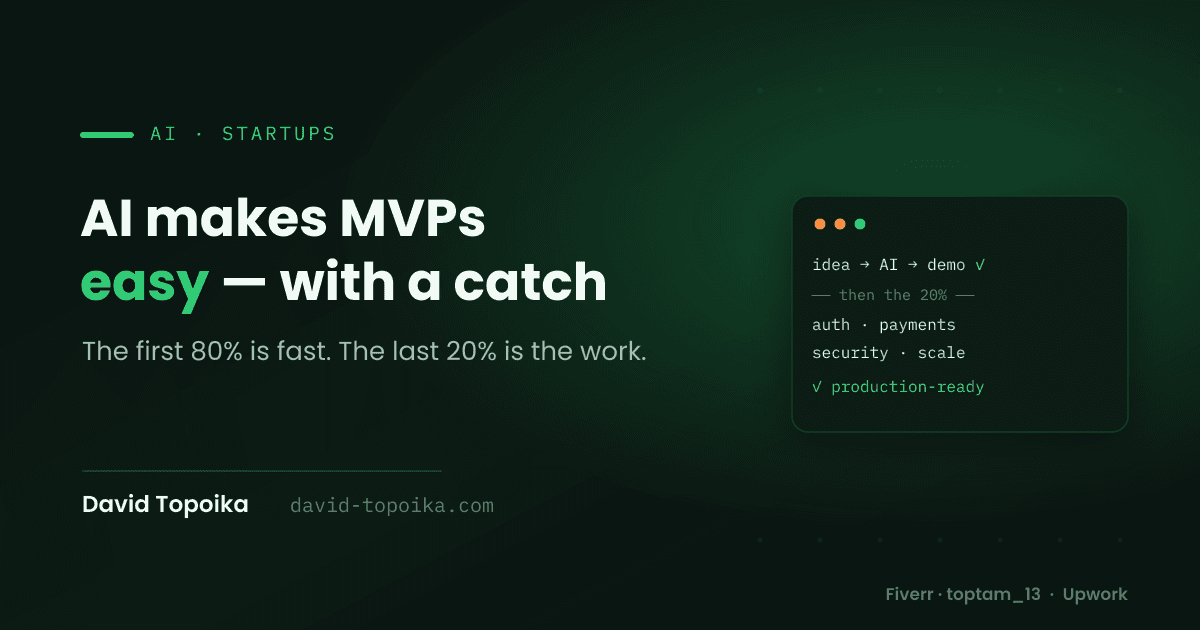
AI coding tools — Cursor and Claude Code for developers, and prompt-to-app builders like Lovable, Bolt, v0, and Replit for founders — scaffold apps, write boilerplate, generate UIs, and let you iterate in plain language. That collapses the repetitive first ~80% of an MVP from weeks into hours. The remaining 20% — auth, payments, security, edge cases, and scale — is where the real engineering, and the real cost, now concentrates.
That's the whole story: AI made the easy part trivial, which means the hard part is now most of the job.
What AI actually accelerates
The speed-up is real and worth taking. AI is excellent at the repetitive, well-trodden 80% of a build:
- Scaffolding and boilerplate — project setup, routing, CRUD, config: the stuff that's the same in every app.
- UI and frontend — generating responsive screens and landing pages from a description, which is where tools like v0 and Lovable shine.
- Wiring integrations — the plumbing to a database, an auth provider, an API.
- Fast iteration — the "describe it, generate it, refine it" loop that turns a vague idea into something clickable in an afternoon.
The result is that a founder can put a real prototype in front of users in days, at a fraction of the old cost. It's such a shift that Y Combinator reported a quarter of its Winter 2025 startups had codebases that were around 95% AI-generated. For validating whether an idea is worth pursuing at all, this is transformative.
The catch: a demo isn't a product
Here's what the hype skips. The last 20% isn't 20% of the work — it's most of the engineering, and it's the invisible part that a happy-path demo never shows:
- Auth that actually holds — not just a login screen, but session handling, token expiry, and the things an attacker would try.
- Payments that don't double-charge — idempotency, reconciliation, and the edge cases that cost real money when they're wrong.
- Data that's secure — proper access control and privacy, not a database anyone can read.
- Code that scales past ten users — the architecture decisions AI doesn't make for you because it's optimising for "works now," not "works at 10,000 users."
- The edge cases — the failures that never appear when you're the only person clicking through.
AI is brilliant at the 80% and unreliable at exactly the 20% that matters most once real users and real money arrive. That's not a knock on the tools — every serious guide says the same thing: vibe coding is worth it for prototypes and MVPs, but only with review, and production still needs architecture and oversight.
What this changes for founders
The upside is huge: you can validate an idea for a fraction of the old cost, put something real in front of users in days, and fail cheap instead of expensive. A rough prototype in front of real users beats a polished product that ships six months too late.
But the bar for "shipped" rose with the floor. When anyone can produce a demo, a demo stops being impressive — and the value moves from typing the code to judgment: what to build, how to structure it, and what "production-grade" actually requires. A prototype that falls over the day it gets traction is its own kind of failure.
Using AI to get to MVP without the mess
The winning move isn't AI or a developer — it's both, in the right order:
- Use AI for the 80% — scaffolding, UI, boilerplate, and fast iteration. Move quick here.
- Review everything that matters — especially auth, database logic, and anything touching money or user data. Never ship code you don't understand.
- Keep the architecture sane — AI optimises for "works in the demo," so someone has to hold the line on structure so you can build on it later.
- Handle the hard 20% deliberately — real auth, payment correctness, security, data modelling, and edge cases get proper engineering, not a prompt.
- Aim for an MVP you can build on — not one you'll have to throw away and rebuild the moment it works.
Where a developer fits now
AI raised the floor — anyone can reach a demo. It didn't raise the ceiling: a real, scalable, secure product still needs engineering judgment. So the most valuable thing a developer does in 2026 isn't typing the first 80%. It's taking the AI head start and making the last 20% real — turning a weekend prototype into something a startup can actually run a business on.
That's the part I love, and the part I do: meeting founders where the AI left off and building the rest properly.
Got an idea — or an AI prototype that needs to become a real product?
If you've validated something with AI and now need it built to actually ship — secure, scalable, and reliable — that's exactly the work I do: take the fast start and make it production-real. Reach out, or find me on Fiverr and Upwork.