What It Actually Takes to Earn 5-Star Reviews
A client in another country, who has never met me, is about to pay me to build something that matters to their business — on the strength of a profile and a few messages. That's the strange reality of remote freelancing: the thing you're really selling isn't code, it's trust, and you're selling it before you write a line. Here's what it actually takes to earn it, one five-star review at a time.
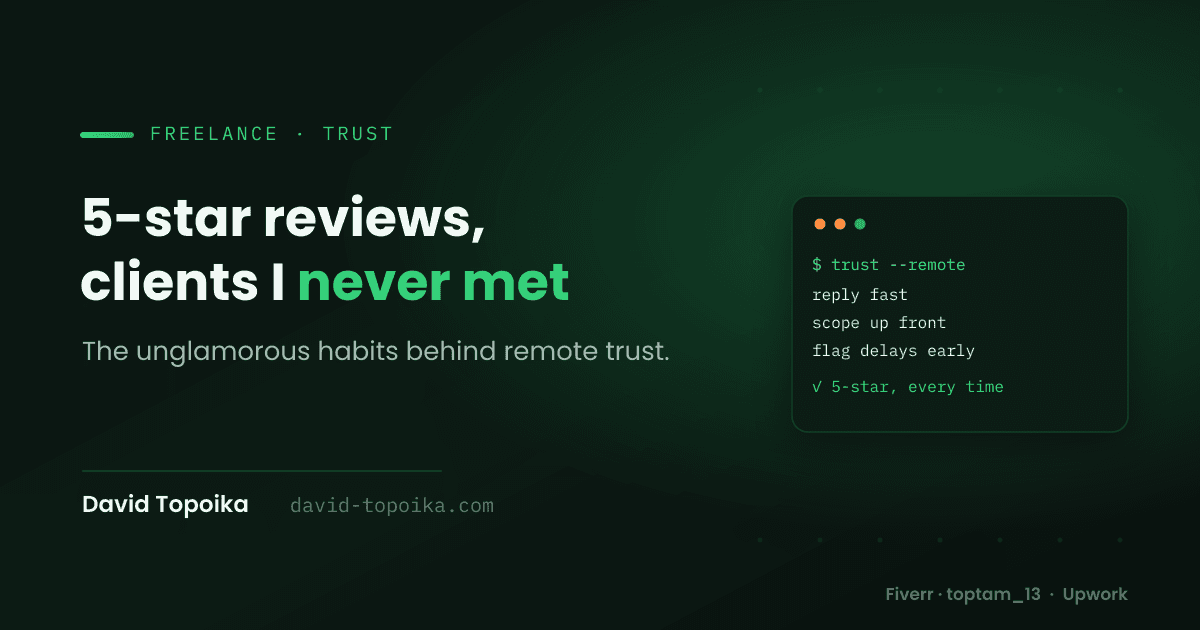
The habits are unglamorous — reply fast, scope clearly, flag problems before the client finds them, deliver what you promised on time. Nothing clever. But done every single time, they're what turn a stranger over a screen into a five-star review. And, not by coincidence, they're exactly what Fiverr's and Upwork's rating systems are built to measure.
Why trust is the actual product when you're hired over a screen
When a client can't walk to your desk, watch you work, or shake your hand, they can't verify much up front — so they're not really buying your skill, they're buying the belief that you'll do what you say. Talent is assumed or sampled from a portfolio; trust is the deciding factor. Every prompt reply, every deadline met, every update you send before they ask is you quietly paying down the risk they took by hiring a stranger.
What clients are really evaluating before day one
Long before they click "hire," clients are reading signals most freelancers don't realise they're sending. How fast and clearly do you reply? Do you ask sharp questions or just say "yes, I can do that"? What's your tone like under a vague brief? And crucially — what do your existing reviews say, since those are social proof from other strangers who took the same risk and were glad they did.
Your first message is often the real interview. Responsiveness and clarity before a contract exists are the best predictor a client has of what the whole engagement will feel like.
The unglamorous habits that build a 5-star track record
There's no trick here, which is exactly why most people skip it:
- Proactive status updates. Tell them where things stand before they have to ask. Silence reads as trouble, even when there isn't any.
- Flag delays early. A problem surfaced early is a manageable adjustment; the same problem discovered late is a broken promise. Early honesty builds more trust than a flawless-looking timeline.
- Scope clearly up front. Most bad reviews aren't about bad work — they're about a gap between what the client pictured and what got delivered. Nailing that down first is the single highest-leverage habit, and it's why I run a proper requirements conversation before quoting .
- Deliver on time, and communicate like a human. Boring. Decisive.
Here's the part that ties it together: those habits are literally what the platforms score. Fiverr's Success Score and Upwork's Job Success Score both weigh communication, responsiveness, on-time delivery, cancellations, and whether clients come back. The behaviour that earns a client's trust is the same behaviour that earns the badge — you're not doing two jobs, you're doing one.
Starting from zero — how to get your first reviews when you have none
The cruelest phase of freelancing is the start: no reviews means no trust, which means no orders, which means no reviews. Breaking that loop takes a deliberate strategy:
- Take smaller, tightly-defined first jobs where it's easy to exceed expectations.
- Price to lower the client's risk, not just to be cheap — you're buying your first proof.
- Over-communicate so you stand out from the freelancers who go quiet.
- Treat a $30 order like it's a $3,000 one, because reputationally, early on, it is.
Those first few reviews are worth far more than their number suggests. They're the thing that lets the next client say yes.
What changes (and what doesn't) as your status grows
As reviews accumulate, you climb — from zero to Fiverr's Level 2 Seller
and Upwork's Rising Talent. Some things genuinely change: clients start coming to you, you can charge more, and you spend less energy convincing people you're safe to hire.
But it's worth being clear about what those badges actually mean, because it's humbler and more honest than the hype. Rising Talent is Upwork's early-stage badge — it flags freelancers with strong potential and early success, not veterans. Level 2 is Fiverr's mid-tier level, earned over roughly four months of completed orders, repeat clients, and a consistently high rating. Neither is a trophy you keep by resting; both are maintained by the exact same responsiveness, delivery, and client satisfaction the algorithms never stop measuring. Status raises the ceiling. The habits are still the floor.
A simple communication checklist for every remote client engagement
If you take one thing from this, take the checklist:
- Reply within a few hours — even just "Got it, looking into this now."
- Confirm scope in writing before starting: what's included, what isn't, what "done" means.
- Send a short, unprompted status update at each milestone.
- Flag any risk or delay the moment you see it — with a proposed fix, not just the bad news.
- Ask a clarifying question instead of assuming.
- At delivery, summarise what you did and how to use it.
- Stay reachable for a reasonable window after handover.
None of that requires more talent. All of it builds the trust that turns a one-time stranger into a five-star review and a repeat client.
Hiring a developer you've never met?
This is exactly how I work — reliability and clear communication first, code second, because over a screen that's what actually matters. If you're weighing whether to trust a remote developer with your product, that's a conversation I'm always happy to start. Reach out, or find me on Fiverr and Upwork.