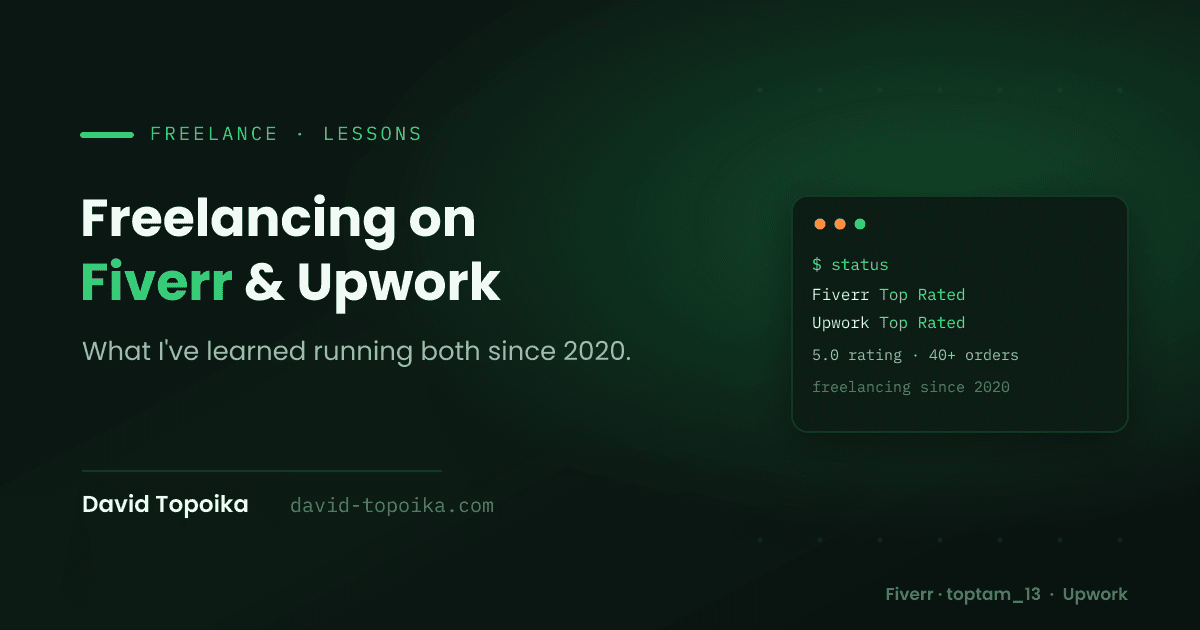
Freelancing on Fiverr and Upwork
I've been freelancing on Fiverr and Upwork since 2020, and today I'm Top Rated on both, with 40+ orders and 5-star reviews across them. But I started exactly where everyone starts: no track record, no reviews, and no idea why nobody was hiring me. Here's what running on both markets has actually taught me — how they differ, what they cost, and what moves you from invisible to booked.
The short version: Fiverr and Upwork are almost opposite in how you get work. On Fiverr you package a service into a "gig" and buyers come to you; on Upwork clients post jobs and you pitch for them. They reward different habits, and most serious freelancers do better being on both.
How the two markets actually work (they're opposites)
On Fiverr, you build a storefront. You create gigs — productized services with fixed packages and prices — and buyers search, compare, and order without necessarily talking to you first. Your visibility comes from gig ranking, conversion, and reviews. You optimise an offer once and let it pull work in. The buyer initiates.
On Upwork, you go hunting. Clients post jobs, and you send proposals — spending Connects each time — making your case per project. Nothing comes to you until you pitch for it. It suits larger, custom, and ongoing work where the client wants to vet you and collaborate. You initiate.
That difference shapes everything. Fiverr rewards a sharp, well-packaged offer; Upwork rewards good proposals and relationships. One is a shopfront, the other is a pitch. Being good at both is two different muscles.
What each one costs
The economics differ as much as the workflow, and the numbers matter when you price:
- Fiverr takes a flat 20% of every order. There's no cost to list a gig or to be found — but their cut per order is the higher of the two.
- Upwork replaced its old tiered structure with a service fee that's now variable — roughly 0–15% per contract, set when you submit a proposal, and effectively around 10% for most freelancers. On top of that you buy Connects (about $0.15 each) to send proposals, which is a marketing cost whether or not you win.
So the trade is real: Fiverr's cut is higher per order but costs nothing to compete for; Upwork's cut is lower but you pay — in Connects and proposal-writing time — for every shot you take. (Fees change often, so check each platform's current fee page before you price.)
Different work tends to flow through each
After a few years on both, a rough pattern holds. Fiverr tends to bring quicker, well-defined, packaged jobs — a buyer who knows what they want and wants it now. OutApp is a good example: a Fiverr client with a clear brief and a fixed timeline. Upwork tends toward bigger custom builds and hourly or ongoing relationships — clients who want to interview you, scope carefully, and work over weeks or months.
Neither is "better." They catch different clients at different moments. Knowing which platform a given piece of work naturally fits helps you price it and pitch it right.
What actually got me to Top Rated on both
The badges aren't a growth hack — they're the residue of doing a few unglamorous things consistently:
- Communication beats everything. Reply fast, set expectations clearly, and send proactive updates. Both platforms weight responsiveness and reviews heavily, and clients remember how it felt to work with you more than the code.
- Scope before you start. Nail down what "done" means up front. Most bad reviews aren't about bad work — they're about a mismatch between what the client imagined and what got delivered.
- Deliver on time, every time. On-time delivery is a tracked metric on both platforms and the foundation under every badge. Protect it.
- Take the small early jobs seriously. The reviews from your first tiny gigs are what unlock the bigger ones. Treat a $30 order like it's a $3,000 one, because reputationally, early on, it nearly is.
The honest early grind
Starting with no reviews is slow and discouraging. You're invisible, you're competing on price, and you're taking work below what you're worth just to get a first rating on the board. That phase is normal, and there's no trick that skips it — the track record compounds. Top Rated on Fiverr and Top Rated on Upwork are both earned over time through consistent delivery, not gamed in a month. If you're in that early stretch and it feels stuck: keep shipping. It does get better.
Which should you start with?
If you can package a clear, repeatable service and want buyers to come to you, start with Fiverr. If you're comfortable pitching and want larger or ongoing projects, start with Upwork. For most people the real answer is both — they reach different clients — with one caveat: don't spread yourself so thin that your response time or quality slips, because fast, reliable communication is exactly what both platforms reward. Better to be excellent on one than mediocre on two.
Working across both — and directly
These days I take work through Fiverr, through Upwork, and directly from clients who find me and prefer to skip the platform entirely. If you're a fellow freelancer: the habits above are the whole game — be reliable, communicate, and let the reviews compound. And if you're a client weighing whether to hire on a platform or reach out directly, either works for me — you'll find me on Fiverr and Upwork, or you can just get in touch.